Hiro Yamagata Official WebSite
Guggenheim Museum and Hiro Yamagata
Resonance with the Architecture of Frank Gehry
Symbol of World Art — The Guggenheim Museum
The Guggenheim Museum is one of the most important art institutions leading the world of modern and contemporary art. With locations in New York, Venice, Bilbao, and other cities, this international network has played a central role in shaping the history of art from the 20th to the 21st century. In particular, the Guggenheim Museum Bilbao, opened in Spain in 1997, is widely known as a museum that transformed the global cultural landscape together with the revolutionary architecture of Frank Gehry. The museum is not merely an exhibition facility. It is a cultural mechanism where architecture, art, and urban regeneration merge. Works presented here are often regarded as symbols of the “art of the future.”
A Rare Presence as a Japanese Artist
Within this international stage, opportunities for Japanese artists to present large‑scale works have been extremely limited. Among the artists who have established a relationship with the Guggenheim Museum is Hiro Yamagata. After achieving worldwide success in the 1980s through his silkscreen works, Yamagata expanded his artistic practice into new territory by combining laser technology, holography, optical science, and environmental installations. His work has been internationally recognized as an art form that uses light itself as a medium.
Exhibition at the Guggenheim Museum — Photon 999
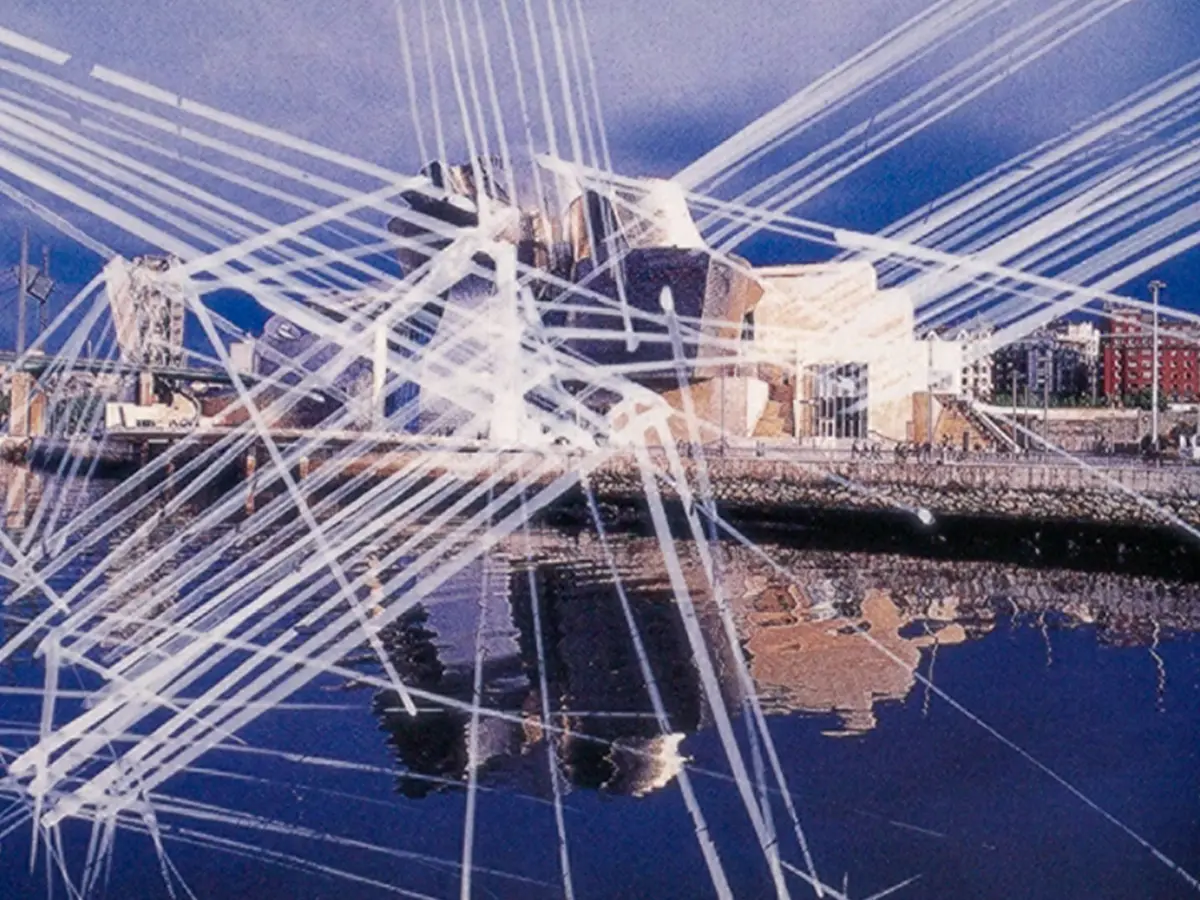
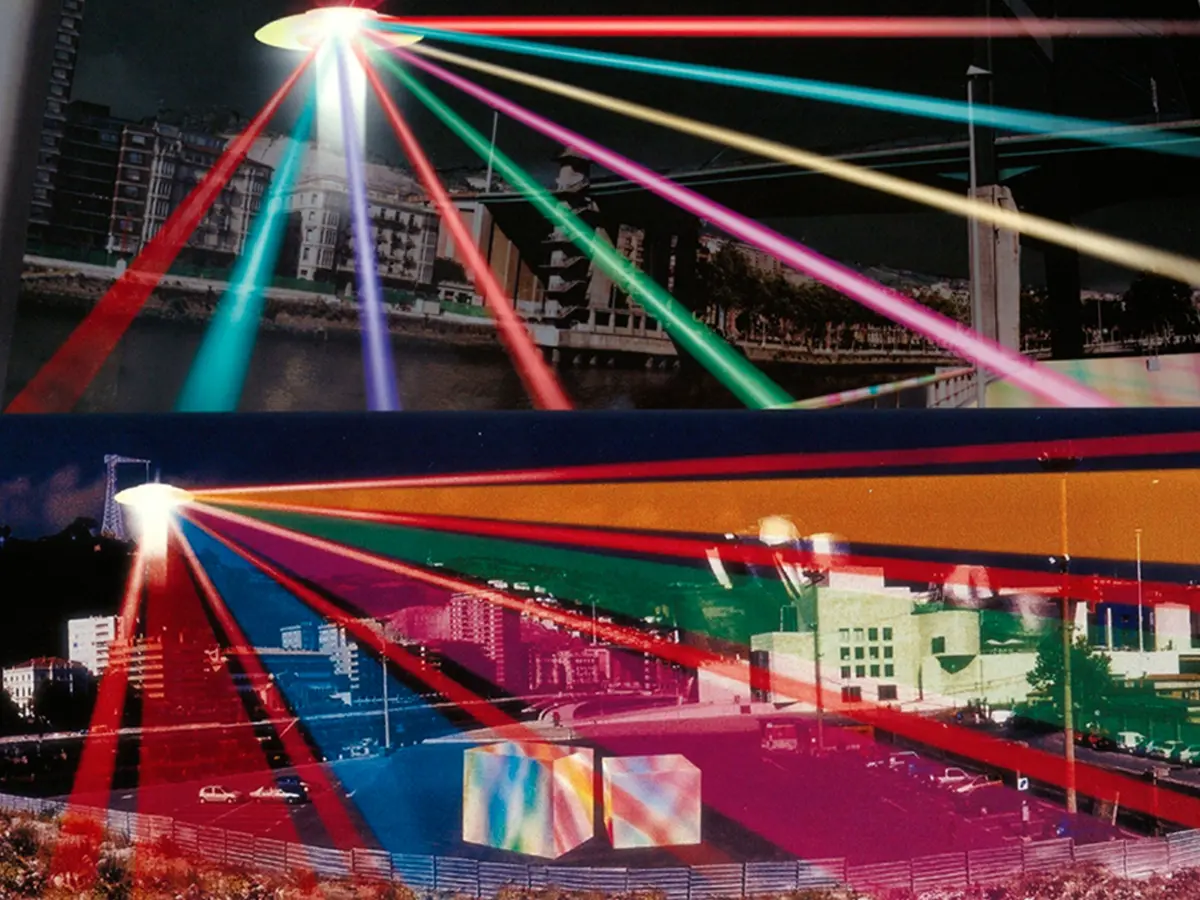
In 1999, the Guggenheim Museum Bilbao introduced Hiro Yamagata’s laser installation work “Photon 999.” In this work, laser light was projected into artificial mist, making the trajectories of light visible in three‑dimensional space. Visitors were able to walk through a spatial environment composed entirely of light. The installation allowed light to appear as if sculpted in space, creating an experience that was considered highly futuristic at the time.
Quantum Field‑X³ — An Installation Experiencing the Universe of Light
One of the representative projects conceived by Hiro Yamagata in Bilbao is “Quantum Field‑X³.” Using a massive holographic cube, the installation reflects and refracts sunlight during the day and artificial light at night, generating an ever‑changing environment of light throughout the space. Visitors walking inside experience shifting spectra of light, changes in color, and subtle spatial fluctuations. It can be considered an artwork that expands human perception itself.
Fusion of Science and Art
At the core of Hiro Yamagata’s work lies a philosophy centered on light and the universe. For many years he has explored the idea that light is the fundamental source of life. Incorporating scientific perspectives such as particle physics and optical theory, he has developed spatial art using laser and holographic technologies.
Resonance with the Architecture of Frank Gehry
The Guggenheim Museum Bilbao is famous for its titanium‑clad curved architecture designed by Frank Gehry. The building changes its appearance depending on the light, which strongly resonates with Hiro Yamagata’s art of light. As architecture responds to light and light reshapes the perception of space, a unique environment emerges where architecture, light, and art merge into a single experience.
Relationship Between Frank Gehry and Hiro Yamagata
1995 Venice “Earthly Paradise” Project
In 1995, world‑renowned artist Hiro Yamagata carried out a large‑scale art project titled “Earthly Paradise” in Venice, Italy. The project was conceived as an international cultural event combining art, architecture, and light installations. The spatial design of the venue involved the participation of world‑famous architect Frank Gehry.
Background of the Project
During the 1990s, Hiro Yamagata expanded beyond his success in silkscreen works to explore new artistic expressions such as laser art and city‑scale installations. One of the symbolic concepts of this exploration was “Earthly Paradise,” planned as an international art project expressing the coexistence of human civilization, nature, and hope for the future.
Held in Venice
Venice, selected as the host city, has been a cultural center where artists from around the world have gathered since the Renaissance. Within this historic city, Yamagata developed a new cultural event that merged contemporary art, light, and architecture.
Venue Design by Frank Gehry
A defining feature of this project was the participation of architect Frank Gehry. At the time, Gehry was already recognized internationally as an innovative architect and would later achieve global fame through the design of the Guggenheim Museum Bilbao in Spain. In the Venice “Earthly Paradise” project, Gehry contributed to the conceptual design of the venue space, creating an environment where architecture and artwork were integrated. The space was designed not merely as an exhibition venue, but as an immersive artistic environment experienced by visitors.
Collaboration Between Art and Architecture
The artistic world of light and color created by Hiro Yamagata resonated strongly with Gehry’s architectural philosophy of free and dynamic forms. This project attracted attention as a new form of cultural expression created through collaboration between artist and architect.
A Relationship Connected to the Guggenheim
The relationship between Hiro Yamagata and Frank Gehry extends beyond a single collaborative project and connects deeply with the broader trajectory of contemporary art and architecture. In 1997, Gehry completed the Guggenheim Museum Bilbao in Spain, a building widely recognized as one of the most influential museum architectures in the world. Hiro Yamagata has also maintained a close relationship with the Guggenheim Museum and has been active within the international network of contemporary art. Both Gehry’s architecture and Yamagata’s art of light symbolize a cultural movement at the end of the 20th century that integrates cities, architecture, and art.
Art Historical Significance
The 1995 Venice “Earthly Paradise” project occupies an important place in Hiro Yamagata’s career as an international cultural project involving collaboration with a leading architect. It is also regarded as one of the projects symbolizing the cultural trend since the 1990s in which art and architecture merge on an urban scale. The collaboration between Hiro Yamagata and Frank Gehry represents an important episode in the historical context where contemporary art and architecture intersect.
The Future of the Art of Light
For decades, Hiro Yamagata has pursued the theme of “Art of Light and the Universe.” His works transcend the boundaries between nature and science, art and technology, reality and perception, continually presenting new possibilities for the art of the future. His exhibition at the Guggenheim Museum, realized through his relationship with Frank Gehry, stands as a symbolic moment in which this artistic challenge gained international recognition.